Execution completion
Did the prescribed workflow complete?
Skill-Oriented OpenFOAM Agents
with Evidence-Driven Evolution
EasyFoam externalizes OpenFOAM expertise into modular skills, references, schemas, and deterministic tools. A coding agent uses these resources to plan, construct, run, assess, and repair a CFD workflow.
A simulation can finish successfully and still miss numerical or physical requirements. The accompanying paper studies this executability–acceptability gap and asks how CFD expertise can be reused and refined across agent implementations.
Did the prescribed workflow complete?
Does the solution meet the required numerical checks?
Do the quantities of interest meet the task criteria?
Task acceptance requires all three dimensions to pass. Missing evidence is not a pass.
Within a task, structured evidence guides construction and targeted repair. Across tasks, experience can inform reusable skill revisions.
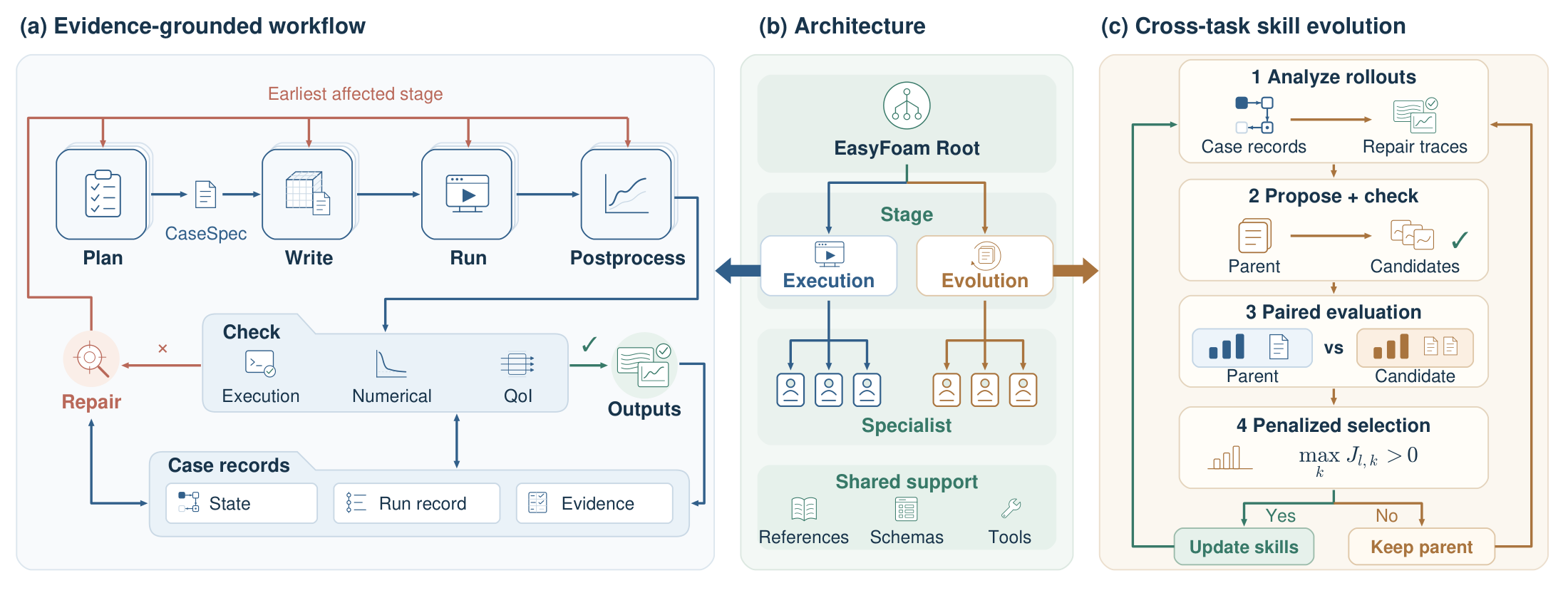
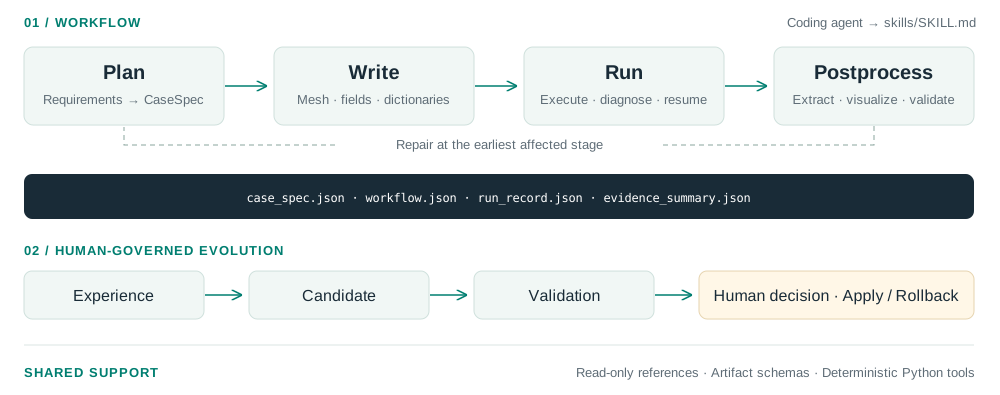
CaseSpec makes requirements explicit. Stage-scoped repair reopens the earliest affected stage and invalidates dependent completion claims, while retaining prior run records.
The paper studies candidate selection through paired evaluation. The released library provides reviewed, reversible updates: applying, retaining, and rolling back changes require explicit human instruction.
The paper evaluates all four systems with the same DeepSeek-V4-Flash backbone and OpenFOAM Foundation v13. Table 1 reports the initial, manually authored EasyFoam skills, before cross-task evolution. Task Acceptance Rate (TAR) requires all three evaluation dimensions to pass jointly.
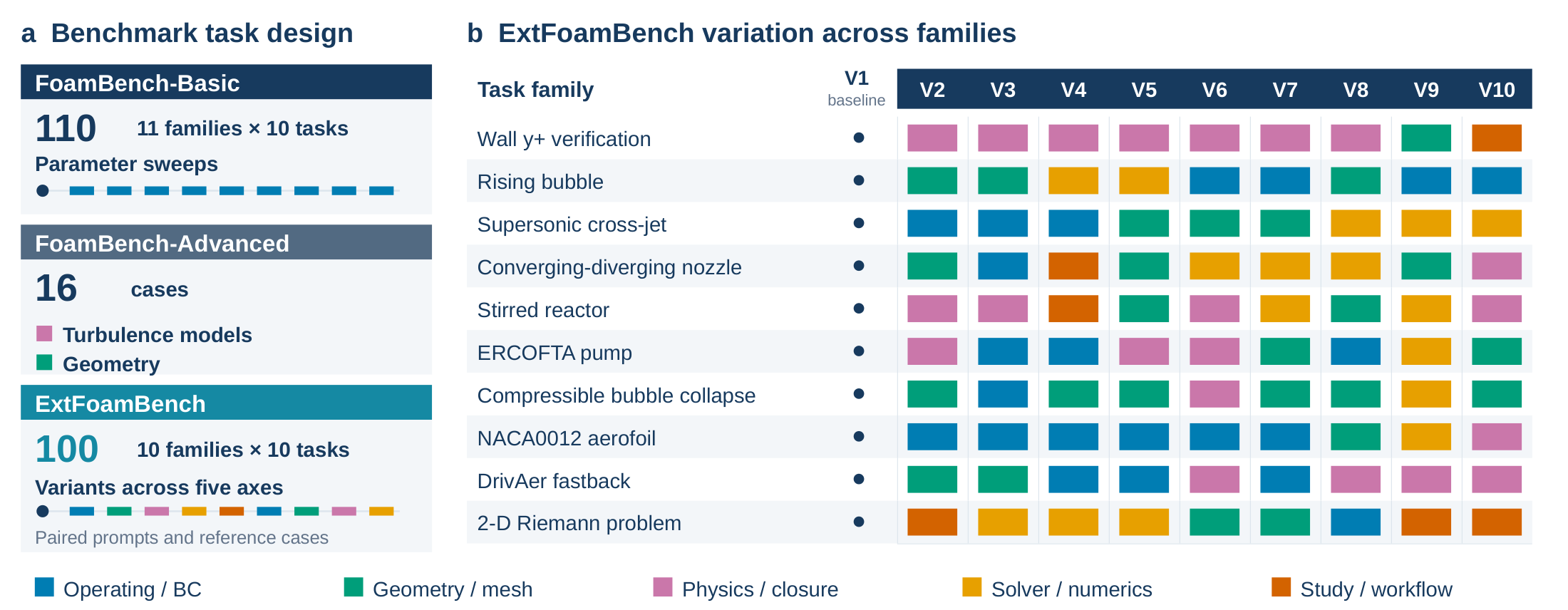
Download ExtFoamBench on Hugging Face ↗: 100 tasks, 7 geometry assets, and task-specific evaluation metrics and acceptance criteria, with offline reference data and evaluation tools as supporting resources.
| Evaluation track | System | Execution | TAR |
|---|---|---|---|
| FoamBench · 126 | MetaOpenFOAM 2.0 | 28.6% | 4.8% |
| Foam-Agent | 59.5% | 4.0% | |
| ChatCFD | 34.9% | 16.7% | |
| EasyFoam | 97.6% | 41.3% | |
| ExtFoamBench · 100 | MetaOpenFOAM 2.0 | 8.0% | 0.0% |
| Foam-Agent | 27.0% | 0.0% | |
| ChatCFD | 13.0% | 0.0% | |
| EasyFoam | 72.0% | 6.0% |
Source: paper PDF, Table 1 (p. 6). These are results of the experimental systems evaluated in the paper, not performance guarantees for this library. ExtFoamBench contains 100 tasks across ten physical families and five axes of variation. Paper ↗
Plan, author, execute, diagnose, validate, and postprocess a case. Recoverable state and immutable run records preserve the evidence trail.
Retain supported experience, propose a frozen patch, validate it, and request a human decision. Changes can be deferred, rejected, or rolled back.
Read-only OpenFOAM and CFD knowledge, seven artifact schemas, and deterministic Python scripts for parsing, validation, execution, and state management.
Use Python 3.11 or 3.12, OpenFOAM Foundation v13, Git, and a coding agent with file and command execution capabilities. Windows runs OpenFOAM through WSL; Linux and WSL support native execution.
git clone https://github.com/CAS-CLab/EasyFoam.git
cd EasyFoam
python3 -m venv .venv
source .venv/bin/activate
python -m pip install -r requirements.txt
git clone https://github.com/CAS-CLab/EasyFoam.git
Set-Location EasyFoam
python -m venv .venv
.\.venv\Scripts\Activate.ps1
python -m pip install -r requirements.txtexport EASYFOAM_OPENFOAM_BASHRC=/opt/openfoam13/etc/bashrc
export EASYFOAM_EXEC_BACKEND=auto
python skills/_shared/scripts/openfoam_env.py discover$env:EASYFOAM_OPENFOAM_BASHRC = "/opt/openfoam13/etc/bashrc"
$env:EASYFOAM_EXEC_BACKEND = "auto"
python skills/_shared/scripts/openfoam_env.py discoverSet the bashrc path to your actual OpenFOAM installation. On Windows, use the path visible inside WSL.
From this repository root, load skills/SKILL.md and use EasyFoam Skills
to complete the following OpenFOAM v13 task.

CFD task:
<your simulation requirements>

Fixed run directory:
<your run directory>
The root skill routes the request. Missing decisive inputs are clarified before the case is released for authoring.
Read the full setup and usage guide →EasyFoam: Skill-Oriented OpenFOAM Agents with Evidence-Driven Evolution introduces the research framework behind this skill library, including evidence-guided workflow repair and cross-task skill evolution. Read the paper for the benchmark design, evaluation protocol, and full experiments.